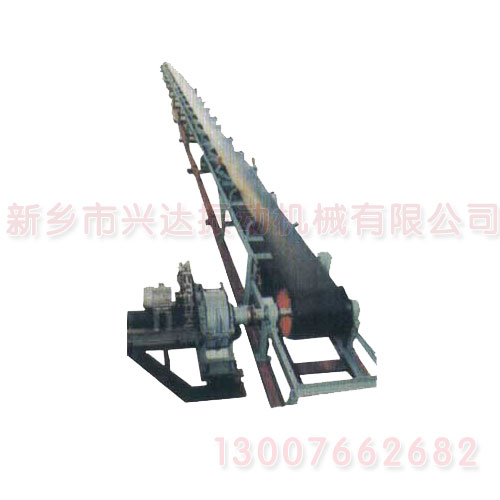
Overview of fixed belt conveyor:
The DTII and TD75 belt conveyors are widely used in metallurgy, mining, coal, ports, transportation, hydropower, chemical and other sectors due to their advantages of large conveying capacity, simple structure, easy maintenance, low cost, and strong universality. They are used for loading, shipping, transferring or stacking various loose materials or packaged items with a density of 500-2500kg/m3 at room temperature The material is transported by a single or multiple unit synthetic transportation system, which can be arranged in a horizontal or inclined form according to process requirements. The DTII type belt conveyor can not only meet the requirements of horizontal or inclined transportation, but also adopt a combination of convex arc segments, concave arc segments, and straight segments for transportation The block size of materials that can be conveyed by a conveyor depends on the bandwidth, belt speed, groove angle, and inclination angle, as well as the frequency of large block materials appearing The working environment temperature suitable for this conveyor is generally -25~+40 ℃ Our company also produces lightweight belt conveyors and mobile conveyors
Basic structure of fixed belt conveyor:
1. Drive part: It consists of an electric motor mounted on a base welded from steel, a high-speed coupling, a reducer, and a reduction coupling. According to the layout requirements, there are two types of drive devices: left mounted and right mounted. In addition, our company is equipped with oil cooled electric rollers with power ranging from 1.5KW to 13KW and speeds of 0.80, 1.0, and 1.25.
2. Rolling part: divided into two categories: transmission drum and reversing drum.
3. Roller section: divided into groove shaped, parallel, self-aligning, and buffering rollers.
4. Cleaning section: divided into spring cleaner and empty section cleaner.
5. Unloading section: divided into fixed plow unloader and electric unloader.
6. Braking part: There are two types: belt backstop and roller backstop.
7. Attachments: in the cover shell, guide groove, funnel, etc.
Working characteristics of fixed belt conveyor:
There are two types of fixed and mobile belt conveyors, DTII and TD75, according to their support structures: adhesive tape, plastic tape, and steel core tape, depending on the material of the conveyor belt. The working environment temperature of the conveyor is generally between -10 ℃ and+40 ℃, and the material temperature is required to not exceed 70 ℃; The heat-resistant rubber belt can transport high-temperature materials below 120 ℃. Belt conveyors should not be used when the material temperature is higher. When transporting materials containing acidic, alkaline oil substances and organic solvents, it is necessary to use oil resistant and acid alkali resistant rubber belt type plastic belts. The belt width of a belt conveyor can be divided into 500, 650, 800, 1000, 1200, and 1400mm. Users can determine the layout of the conveyor, as well as the selected belt width, canvas layers, and belt thickness, based on factors such as the conveying length, material type, bulk density, conveying capacity, and conveying length.